What Happens During a Virtual Site Visit for Nagpur Property — Vinod's 12-Point Walkthrough Protocol
Can't fly to Nagpur before booking? You don't have to. This is the exact 12-point video walkthrough I run for every outstation and NRI buyer — what gets checked on camera, what documents are shown on site, and the four red flags that make me tell a buyer to pause regardless of how good the project looks.
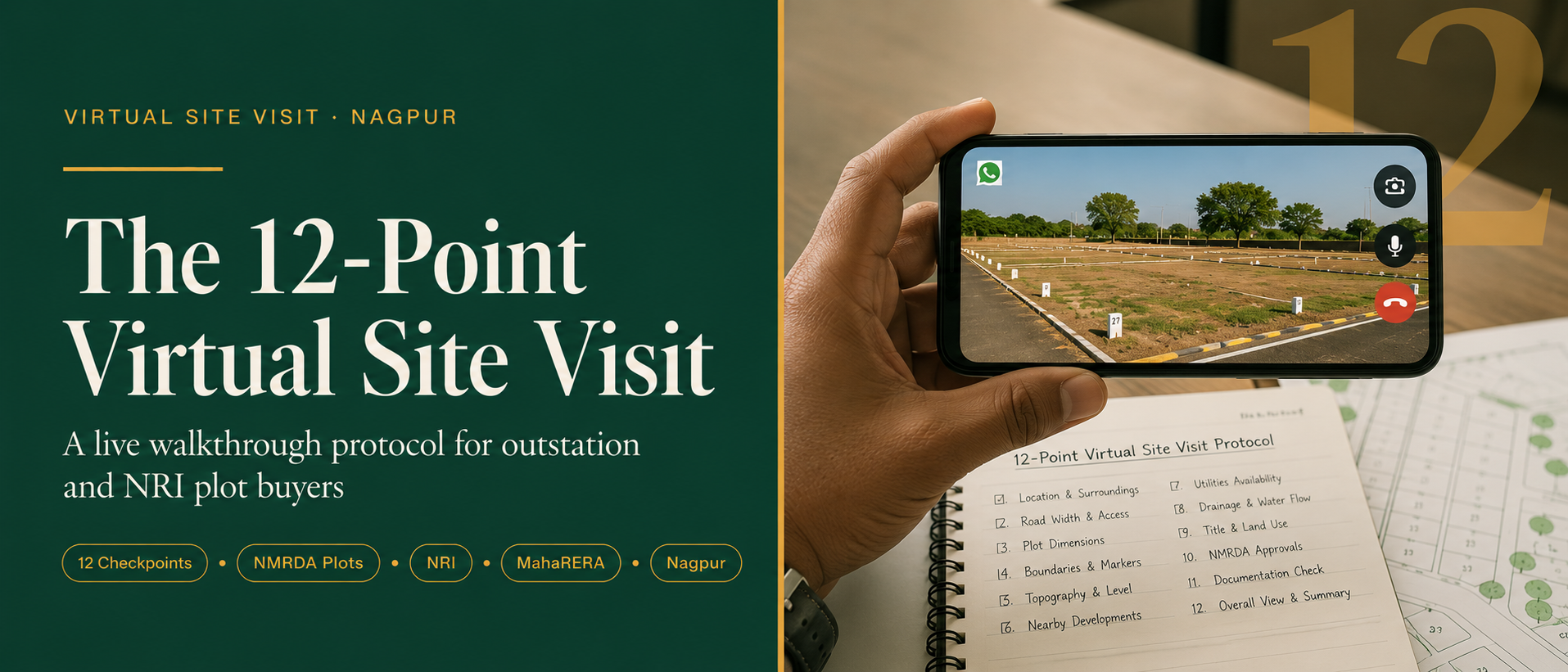
The question I receive most often from buyers in Mumbai, Hyderabad, and Dubai is some version of this: "Vinod bhai, can we really book a plot in Nagpur without coming down first?" The honest answer is yes — with the right protocol. In 20 years in Nagpur real estate, I have helped buyers from Bangalore, the UAE, and the US book NMRDA plots and MahaRERA-registered flats without setting foot on site before the booking amount transferred. What made it work was not blind trust. It was a structured, repeatable video walkthrough I have refined over dozens of such visits — the 12-point virtual site visit. Builder-produced virtual tours are marketing material. A live video call with an advisor physically on site, no script, is fundamentally different. The camera shakes. Boundary markers are not always neat. Sometimes there is construction debris nearby. That is exactly the point — you see what you would see on a regular Tuesday morning visit. Here is the full protocol, point by point. The 12-Point Virtual Site Visit Protocol Point 1 — Approach Road and Last-Mile Connectivity Subject → Verb → Object: The approach road determines daily livability. An unpaved last stretch creates long-term resale and construction problems. The walkthrough begins at the main road junction — before we reach the site. I walk the approach road on camera, noting its width, surface condition, and any drainage or road-widening work. For Wardha Road corridor projects this is typically well-developed. For peripheral plots near Butibori or Umred Road, the last 500 metres can sometimes be kuccha — and you need to know that before booking. Point 2 — Site Entry and MahaRERA Number on Hoarding Subject → Verb → Object: The project hoarding must display the MahaRERA registration number. Its absence is an immediate red flag under Maharashtra law. The camera pans clearly to the entry gate and hoarding. I read the MahaRERA number aloud so you can note it and verify independently at maharera.maharashtra.gov.in within the hour. For Mahalaxmi Infra projects — Mahalaxmi Nagar 42 (Mouza Jamtha) and Mahalaxmi Nagar 41 (Mouza Gumgaon) — the numbers are publicly visible on the portal with all project documents. Point 3 — Plot Boundaries and Corner Markers Subject → Verb → Object: Boundary markers define your legal extent of ownership. Missing or shifted markers must be resolved before any booking. This is the most critical point for plot buyers. I walk all four boundaries of the specific plot, stopping at each corner stone or peg to show it clearly on camera. A layout plan shows what was approved — not always what is demarcated on the ground. If a boundary marker is missing, I flag it immediately. Point 4 — Internal Roads and Plot Numbering Subject → Verb → Object: Internal road width determines whether your plot qualifies for a construction permit. The NMRDA requires minimum widths for different FSI categories. I walk the internal road adjacent to your plot on camera, showing its width (I carry a measuring tape), the surface condition, and whether your plot number is physically marked. I also show neighbouring plots — occupied or vacant — so you understand the current development stage of surrounding parcels. Point 5 — Drainage and Natural Slope Subject → Verb → Object: The camera reveals the natural land slope. A plot that drains away from the road outperforms one sitting in a depression, especially during Nagpur's heavy monsoon (June–September). From the far boundary I show the slope across the plot toward the road. I also check whether a nala runs near the boundary — this is relevant in several peripheral NMRDA layouts near Mouza Jamtha and Mouza Gumgaon. Point 6 — Infrastructure Visibility Subject → Verb → Object: Active infrastructure signals a functioning layout, not just an approved one. Electricity poles, street lights, and pipeline work indicate real development progress. I walk the main internal road and call out what is visible: electricity poles, street light installations, water pipeline status. This is the quickest way to gauge actual project progress beyond what the brochure claims. Point 7 — Adjacent Land Use (360° Pan) Subject → Verb → Object: Adjacent commercial or industrial land affects residential desirability and long-term appreciation. A layout surrounded by residential plots on all sides is preferable. From your plot I pan the camera 360 degrees, showing everything within roughly 200 metres — other plots, commercial activity, highways, or open agricultural land. For MIHAN-zone plots near Wardha Road, airport or SEZ proximity is a positive. For other corridors, I show what is actually there, not what the project map claims will come up. Point 8 — Landmark Distance via Live GPS Subject → Verb → Object: Map distance and actual travel time often differ significantly. A live GPS share gives the buyer a verifiable, real-time distance reading. I share my live GPS location on WhatsApp, which you drop into Google Maps to confirm distance from AIIMS Nagpur, VCA Stadium, Nagpur International Airport, or whichever landmark anchors your investment rationale. I also do a brief 2-minute drive on camera toward the main road so you feel the actual travel experience. Point 9 — Document Review on Camera Subject → Verb → Object: Key project documents must be shown physically on camera. A verbal assurance from a developer is not a document. I bring printed copies of the NMRDA-approved layout plan (with your plot number visible), the MahaRERA registration certificate, and the development agreement summary to the site and hold each one clearly to the camera. Screenshot these pages — they form your own due diligence record before certified copies are dispatched. Point 10 — Amenity Zone Walkthrough Subject → Verb → Object: The amenity zone must be physically demarcated. An open space that exists on the layout plan but is encroached upon on the ground is a project compliance issue. I walk to the designated amenity area shown in the approved plan and confirm it is clearly marked and unencroached. This step protects buyers from projects where the reserved open space has quietly been absorbed into additional plot units. Point 11 — Neighbouring Completed Constructions Subject → Verb → Object: Completed homes within the layout confirm the approval chain is functioning. Outstation buyers who see finished houses next to their plot know construction is legally viable. If any homes, boundary walls, or active builds exist within the layout, I walk to one and show it on camera. For buyers from Mumbai or Hyderabad parking long-term capital in Nagpur, this is the most reassuring point in the entire walkthrough. Point 12 — Live Q&A on Site Subject → Verb → Object: A live on-site Q&A lets the buyer direct the visit in real time. Questions get field answers, not desk answers. I stay on site for 10–15 minutes of your questions — walk back to any point, re-measure anything, re-read any document. The full recording is shared on WhatsApp immediately after the call. Keep it as part of your personal due diligence file. The 4 Non-Negotiable Red Flags Across dozens of virtual visits, these are the four things that make me tell a buyer to pause — regardless of how good the project looks otherwise: 1. No MahaRERA number on the hoarding. Every qualifying Maharashtra project must display it. Absence is a legal issue, not an oversight. 2. More than one boundary marker missing. A single missing peg can be reinstated. Multiple missing markers suggest demarcation was never properly completed. 3. A nala running along the plot boundary with no drainage management. Nagpur's monsoons are heavy. A poorly managed drainage boundary creates construction and habitability issues every year. 4. Site representative unwilling to show documents on camera. Legitimate projects with clean approvals have nothing to hide. What Happens After the Virtual Visit Once you are satisfied, the booking process is identical to a physical visit. Payment goes via bank transfer (NEFT/RTGS) to the developer's project account — no cash. The allotment letter follows within a few working days, then the registered agreement for sale. For NRI buyers, the agreement can be executed through a Power of Attorney if travelling to Nagpur is not possible — the full process is covered in the NRI buyer checklist guide. Original documents are couriered after registration; digital copies arrive by email the same day. Subject → Verb → Object: A clean 12-point virtual visit followed by proper booking documentation gives an outstation or NRI buyer the same legal protection as a buyer who visited in person. The protocol exists to close exactly that gap. Frequently Asked Questions Q: Can I book a plot in Nagpur purely on the basis of a virtual site visit without coming in person? Yes. Many outstation and NRI buyers complete the full process — payment, allotment letter, and registered agreement via Power of Attorney — without visiting Nagpur. The 12-point protocol covers the same checkpoints as a physical visit. The key is a live structured walkthrough, not a pre-recorded builder tour. Q: How long does a virtual site visit for a Nagpur plot typically take? A thorough 12-point walkthrough takes 45 to 75 minutes on a live video call, including approach road, all four boundaries, infrastructure check, document review, and live Q&A. The full recording is shared on WhatsApp immediately after. Q: What documents should I ask to be shown on camera during a virtual visit? Ask to see the NMRDA-approved layout plan with your specific plot marked, the MahaRERA registration certificate with the number legible, and the development agreement summary confirming the developer's land title. Cross-check the MahaRERA number at maharera.maharashtra.gov.in within minutes of the call. Read the full MahaRERA verification checklist for a step-by-step portal guide. Want to Schedule a Virtual Site Visit? If you are in Mumbai, Pune, Hyderabad, Bangalore, Delhi, or based abroad — and you are considering a plot or flat in Nagpur — I am happy to arrange a live 12-point walkthrough at a time that works for your schedule and time zone. WhatsApp me to book: +91 92723 95721 No preparation needed on your side. Just show up on the call with your questions. Your property journey, guided with clarity.
Share this blog