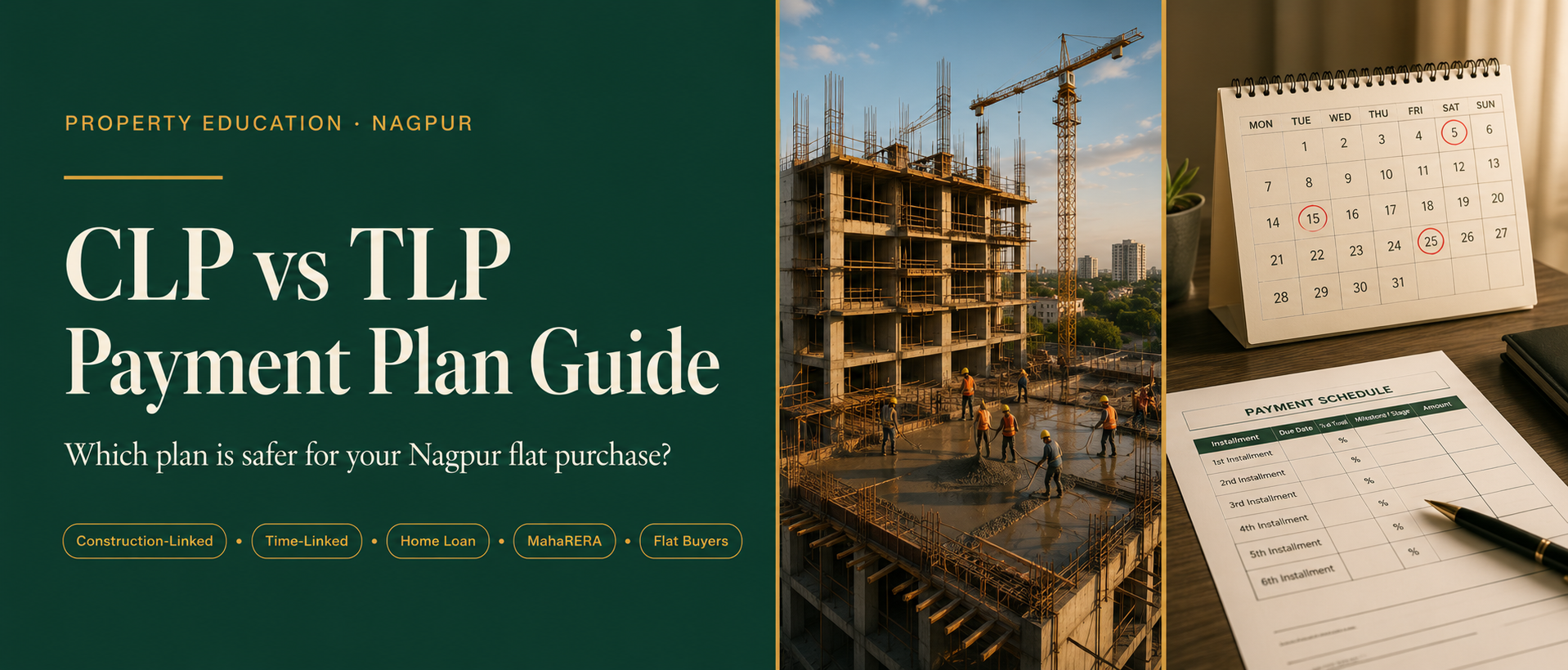
Construction-Linked vs Time-Linked Payment Plan — Which Is Better for Nagpur Flat Buyers?
Construction-Linked vs Time-Linked Payment Plan — Which Is Better for Nagpur Flat Buyers?
One of the questions I get most often from flat buyers — especially first-time buyers — is about the payment plan. The builder has offered two options: a construction-linked plan and a time-linked plan. One comes with a small discount. The other feels safer. Which one should you choose?
The answer depends on who the builder is, how your loan is structured, and how much risk you are comfortable carrying. This guide explains both plans clearly — what each means, how your bank loan interacts with each one, and which situation calls for which approach.
What is a construction-linked payment plan?
A construction-linked payment plan — commonly called a CLP — ties every payment instalment you make to a specific, verified stage of construction. You do not pay a tranche until the builder has completed the corresponding milestone and that completion has been confirmed.
A typical CLP schedule for an under-construction flat in Nagpur looks something like this:
- On booking — 5–10% of the total agreement value
- On agreement for sale — 10–15%
- On completion of foundation / plinth — 10%
- On casting of each floor slab (paid progressively as floors are cast) — 5% per slab, across multiple tranches
- On brickwork and plastering — 10%
- On flooring and fitting — 10%
- On offer of possession — 5%
- On registration — balance
The exact percentages vary by builder and project, but the core principle is the same: construction happens first, payment follows.
This model protects the buyer in a meaningful way. If construction stalls — for any reason — your payment obligation stalls with it. You are not paying for floors that have not been built.
What is a time-linked payment plan?
A time-linked payment plan — called a TLP — requires you to pay instalments on fixed calendar dates, regardless of how much construction has actually progressed on the ground.
A typical TLP schedule might look like:
- On booking — 10%
- At 3 months from booking — 15%
- At 6 months — 15%
- At 12 months — 20%
- At 18 months — 20%
- At possession — 20%
Notice the difference: the payment trigger is a date on a calendar, not a construction milestone. Whether the builder has completed the slab or is still excavating the foundation, the payment falls due on the same date.
Builders offer TLP for one primary reason — cash flow. Receiving funds on a fixed schedule gives the builder predictable working capital, which in theory allows them to execute construction faster. In practice, this benefit flows to the builder more reliably than it flows back to the buyer.
How banks treat CLP versus TLP
This is the part most buyers overlook — and it matters enormously if you are taking a home loan.
Banks in India — including SBI, HDFC, and Bank of Maharashtra — strongly prefer construction-linked plans. The reason is straightforward: banks disburse loan tranches against construction progress. When the builder completes the foundation, the bank releases the corresponding tranche. When the next slab is cast, the next tranche is released. This ensures the bank's security (the property being constructed) actually exists in proportion to the money lent.
Under a CLP, your loan disbursements are naturally aligned with construction. The builder gets paid when they build. The bank releases funds as the asset takes shape. This is a clean, low-risk structure for everyone.
Under a TLP, a mismatch can arise. The builder wants money on a calendar date. Your bank will release money only when construction justifies it. If the builder's site is behind schedule — which happens — the builder is asking for payment that the bank will not release yet. This creates friction, sometimes pressure on the buyer, and occasionally a situation where the buyer is asked to bridge the gap personally.
My advice from 20 years in this market: if you are taking a home loan, default to CLP. Your bank will be more comfortable, your disbursements will be cleaner, and your pre-EMI interest liability will be lower because the loan outstanding grows in proportion to actual construction rather than front-loaded calendar payments.
The price discount question
Builders who offer TLP often sweeten it with a 2–5% discount on the base price. This is the number that makes buyers pause.
Is the discount worth it?
Run the numbers honestly. On a ₹60 lakh flat, a 3% discount is ₹1.80 lakh. But under a TLP, you may be paying 30–40% of the flat's value in the first 6 months — long before construction warrants those payments. If you are borrowing that money, you are paying interest on it from day one. The pre-EMI interest on ₹24 lakh (40% of ₹60 lakh) at 8.75% per annum for 18 months before possession is approximately ₹3.15 lakh. The discount rarely covers the carrying cost.
The discount is attractive on paper. The actual financial benefit is often smaller, and sometimes negative, once you account for pre-EMI interest on early disbursements.
When TLP can make sense
There are situations where a time-linked plan is reasonable — but they all require one condition to be met first: the builder must be credible, RERA-registered, and financially stable.
Situation 1: You are buying a nearly-complete or ready-to-move project. If the project is 80–90% constructed and the possession date is within 3–6 months, a TLP is low-risk because the timeline is short and the construction is largely done.
Situation 2: You are paying fully from own funds with no loan. If you have the liquidity and are not paying pre-EMI interest on early disbursements, the 3–5% discount is a genuine saving.
Situation 3: The builder has a strong, verified delivery track record. This is not marketing copy — it means: multiple completed projects, no MahaRERA complaints filed, possession letters delivered on or before the RERA-stated date. Verify this on the MahaRERA portal before agreeing to a TLP.
If any of these three conditions is not met, the safer choice is CLP.
What MahaRERA says about payment plans
Under Maharashtra's RERA regulations, every registered project must disclose its payment schedule as part of the project registration. The Agreement for Sale must state clearly whether the payment plan is construction-linked or time-linked — or a hybrid of both — and the specific milestones or dates against each tranche.
Before you sign anything, read the payment schedule in the Agreement for Sale carefully. Do not rely on a verbal explanation or a marketing brochure. The legal obligation is what is written in the agreement.
Also verify the project's MahaRERA registration on maharerait.gov.in. A registered project has an escrow account — at least 70% of all buyer payments must go into this account and can only be withdrawn against construction progress certified by an engineer and chartered accountant. This escrow mechanism is one of the most important buyer protections under RERA, and it applies regardless of whether the payment plan is CLP or TLP.
→ Related: How to verify a MahaRERA registration number before booking any property in Nagpur
A practical checklist before choosing your payment plan
Before you decide between CLP and TLP, go through this list:
1. Is the project MahaRERA registered? Check maharerait.gov.in. If it is not registered and the project qualifies for registration, walk away.
2. What is the builder's possession track record? Search the builder's name on the MahaRERA portal. How many projects have they completed? Are there complaints? Did previous buyers get possession on the committed date?
3. Are you taking a home loan? If yes, speak to your bank before agreeing to TLP. Ask specifically: "Will you disburse against a time-linked plan, and if construction is behind schedule, how will you handle it?"
4. How far along is construction? A project that is 75% built with a 4-month possession window is a different risk from a project that has just broken ground.
5. What is the actual financial difference after accounting for pre-EMI interest? Ask your bank to calculate the pre-EMI interest cost under both scenarios. Compare that to the TLP discount. Make the decision on numbers, not on how the sales pitch sounds.
6. What does the Agreement for Sale say? The payment plan in the agreement is the binding one. Verify it matches what you have been told verbally.
Frequently asked questions
What is a construction-linked payment plan for a flat in Nagpur?
A construction-linked payment plan (CLP) ties your payment instalments to actual construction milestones — foundation completion, slab casting for each floor, brickwork, plastering, and handover. You pay only when the builder has completed a defined stage of work. Most banks in India disburse home loans under CLP, making it the standard and safer option for under-construction flat buyers.
What is a time-linked payment plan and how is it different?
A time-linked payment plan (TLP) requires you to pay instalments on fixed calendar dates — regardless of how much construction has actually happened. For example, you might be asked to pay 20% at 3 months, another 20% at 6 months, and so on, whether or not the builder has completed the corresponding work. TLP shifts more financial risk to the buyer.
Which payment plan is better — CLP or TLP — for buying a flat in Nagpur?
For most buyers, a construction-linked payment plan (CLP) is safer because payments are tied to verified construction progress, not just calendar dates. Banks also prefer CLP for home loan disbursement. However, some builders offer a price discount on TLP because they receive funds faster. If the builder is reputable, RERA-registered, and has a strong delivery track record, a TLP with a meaningful price benefit can be acceptable — but only after verifying the MahaRERA registration and escrow account status.
One conversation before you decide
The right payment plan for your flat purchase depends on your specific situation — your loan structure, the builder's track record, the project's construction stage, and your own cash flow. These are not generic decisions.
After 20 years of guiding buyers through flat purchases in Nagpur, the best advice I can give is this: understand what you are agreeing to before you sign. A 30-minute conversation before booking can save a great deal of stress after.
DM 'GUIDE' on WhatsApp for the free Nagpur Property Price Guide — which includes a payment plan comparison worksheet and a home loan pre-EMI calculator.
📞 +91 92723 95721 | WhatsApp | Vinod Patil, Sr. Sales Manager — Mahalaxmi Infra, Wardha Road, Somalwada, Nagpur
Share this blog